
The Central Board of Secondary Education has put an end to weeks of confusion surrounding its revised three-language framework. In a fresh set of implementation guidelines dated July 10, 2026, the Board has spelled out exactly how CBSE’s R3 language rule — its official term for the third language, referred to in communication simply as R3 — will be treated for students who are currently studying in Class 9 and will move into Class 10 during the 2027-28 session.
The short version: R3 will not show up as a paper in the Class 10 board examination for this particular batch. But that does not mean the subject can be ignored. Every student in this group must still pass a school-conducted internal assessment in R3, and clearing it has now been made a precondition for receiving the CBSE Secondary School Examination pass certificate. In other words, the language will not be board-examined, yet it remains non-negotiable for certification.
What the July 10 Circular Actually Clarifies
Until CBSE’s Implementation Guidelines dated July 10 arrived, schools, parents and students were largely guessing at how the third-language requirement would be evaluated once the affected batch reached Class 10. The Board has now removed that ambiguity in plain terms. Students who are presently in Class 9 during 2026-27 and will therefore sit their board exams in 2027-28 will not face a written R3 paper set and evaluated by CBSE. Instead, each affiliated school will run its own internal assessment for the subject, following the framework the Board has already circulated.
Passing this internal test is not optional. The circular states clearly that qualifying the school-based R3 assessment is a mandatory condition for being awarded the Class 10 pass certificate. A student could clear every board-examined subject and still find their certification held up if the R3 assessment has not been cleared.
A Built-In Second Chance Under CBSE’s R3 Assessment Requirement
CBSE has also addressed what happens when a student does not clear the assessment on the first attempt. Under CBSE’s R3 language rule, the circular directs schools to conduct a reassessment for any such student before the Class 10 results are formally declared. This effectively builds a safety net into the process — a student is not permanently blocked by one unsuccessful attempt, but the school is now responsible for arranging and completing a retest within the results timeline, rather than leaving it pending.
Class 9 Students Are Not Left Without a Cushion Either
The guidelines don’t stop at Class 10. CBSE has also addressed students currently sitting in Class 9 who may be unable to clear the R3 assessment this academic year. Such students will still be promoted to Class 10 as usual — their promotion is not held hostage to this one subject. However, the assessment they missed does not simply disappear; it carries forward, and they will be expected to clear the pending Class 9 R3 evaluation alongside their coursework in the following academic year.
To support this rollout, the Board has confirmed that the assessment structure for Class 9 has already been shared with schools, and language-learning material is being made available through the National Council of Educational Research and Training, so that schools are not left to build resources from scratch.
Revisiting CBSE’s R3 Language Rule and the Three-Language Formula
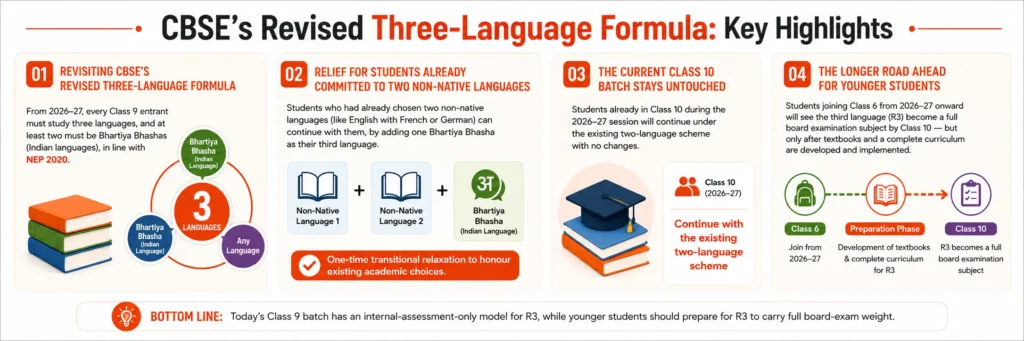
To understand why this circular matters, it helps to step back to the broader policy CBSE’s R3 language rule sits under. The July 10 notification builds directly on implementation guidelines the Board had already issued on June 29, both of which trace back to the language provisions envisioned in the National Education Policy, 2020.
Under this revised structure, every student who joined Class 9 from the 2026-27 academic session onward is required to study three languages rather than two, and at least two of those three must be Bhartiya Bhashas — that is, Indian languages. This is the change that introduced R3 as a formal requirement in the first place.
Relief for Students Already Committed to Two Non-Native Languages
CBSE has recognised that plenty of students had already chosen to study two non-native languages, such as English paired with French or German, before this policy took shape. Rather than forcing an abrupt switch, CBSE’s R3 language rule grants a one-time transitional relaxation. These students may continue with the two non-native languages they had already picked, provided they add one Bhartiya Bhasha as their third language. This keeps existing academic choices intact while still bringing every student into the Indian-language requirement.
The Current Class 10 Batch Stays Untouched
Importantly, none of this affects students who are already in Class 10 during the 2026-27 session. The Board has explicitly clarified that this group will continue under the older two-language scheme they were originally following, with no changes introduced mid-course.
The Longer Road Ahead for Younger Students Under CBSE’s Third Language Mandate
Looking further out, students who join Class 6 from the 2026-27 session onward are on a different track altogether. For this cohort, the third language is expected to eventually become a full board examination subject once they reach Class 10 — but only after dedicated textbooks and a complete curriculum for R3 have been developed and rolled out. So while today’s Class 9 batch gets an internal-assessment-only model, younger students should expect R3 to eventually carry the same weight as any other board-examined subject.
CBSE’s R3 Language Rule Still Faces a Legal Challenge
None of this rollout has happened without pushback. The three-language framework is currently the subject of an ongoing case before the Supreme Court, brought by a group of parents together with teachers of foreign languages.
What the Petitioners Are Arguing
The core of their objection is timing and preparedness. They contend that the policy was rolled out after the academic session had already begun, leaving schools little room to adjust. Their petition also raises concerns about whether enough trained language teachers are actually available, whether textbooks exist in time, and whether the added subject places an unfair academic burden on students who are already managing a full course load.
How CBSE Has Responded to R3 Language Rule Challenges in Court
The Board, for its part, has pushed back on these concerns with data of its own. It has told the Court that close to half of its affiliated schools already teach two or more Indian languages at the Class 9 level, and that more than 99 percent of affiliated schools already have at least one Indian-language teacher on staff. CBSE has maintained that CBSE’s R3 language rule, through the June 29 and July 10 guidelines, was designed specifically to iron out the operational gaps the petitioners have flagged — covering staffing flexibility, learning resources and phased timelines. The Board has repeatedly stressed that its underlying goal is meaningful multilingual learning rather than adding another exam, and that it does not intend for any student to be disadvantaged during the transition.
What This Means for Parents and Students Right Now
For a student currently in Class 9, the practical takeaway is straightforward: R3 will not be a board paper next year, but it absolutely cannot be skipped. Clearing the school-level assessment is now tied directly to receiving the Class 10 pass certificate, so it deserves the same seriousness as any board subject, even without a formal exam attached to it. Parents would do well to check with their school which Bhartiya Bhasha is being offered, how the internal assessment will be structured, and what the reassessment window looks like in case the first attempt doesn’t go as planned.
Questions Worth Raising With Your School
A few conversations can save families a lot of last-minute stress later. It’s worth asking which Bhartiya Bhasha the school has finalised for R3, whether a qualified language teacher is already in place, and how frequently the internal assessment will be conducted through the year rather than crammed into a single sitting. It’s equally useful to ask how the reassessment process will actually run in practice — whether it happens immediately after the first attempt or is bundled closer to the results timeline — so that a student who needs a second try isn’t scrambling at the last moment.
Why a Non-Board Subject Still Deserves Full Attention
It’s tempting to assume that anything outside the board examination automatically carries less weight, but that assumption doesn’t hold here. Because the R3 assessment sits directly between a student and their pass certificate, treating it as a low-priority subject could create last-minute complications that have nothing to do with a student’s performance in their main board subjects. Schools that build R3 preparation into the regular academic calendar, rather than treating it as an afterthought, are likely to see far fewer students needing the reassessment route at all.
Final Takeaway
Language policy in Indian schools is clearly moving toward a more India-rooted, multilingual model, and CBSE’s July 10 circular shows the Board trying to balance that larger vision against the practical realities schools are dealing with on the ground. At Mata Nand Kaur Public School, a CBSE school in Najafgarh Delhi, we track every one of these CBSE circulars closely and build our internal timelines around them well in advance, so that our students are never caught off guard by a policy update — whether it concerns R3 assessments, board exam patterns, or certification requirements. Parents evaluating cbse schools in najafgarh should look for exactly this kind of preparedness: a school that treats regulatory changes as routine planning rather than last-minute scrambling.
FAQ’s
R3 refers to the third language CBSE has made compulsory under its revised three-language policy aligned with NEP 2020. Every student must study three languages from Class 9 onward, with at least two being Bhartiya Bhashas, and R3 is the designation for this third language slot.
No. Students already in Class 10 during the 2026-27 session continue under the old two-language system and don’t need to study or clear a third language at all.
Not for the batch currently in Class 9 (moving to Class 10 in 2027-28). For them, R3 is assessed only through an internal, school-conducted evaluation — there’s no CBSE board paper for it.
The school must conduct a reassessment before Class 10 results are declared, giving the student another chance to clear it before certification.
For students entering Class 6 from 2026-27 onward, R3 is expected to become a board-examined subject once they reach Class 10, once dedicated textbooks and curriculum are finalized.
A group of parents and foreign-language teachers has petitioned the Supreme Court, arguing the policy was introduced abruptly mid-session with concerns over teacher availability, textbook readiness, and added academic burden on students.
Yes — CBSE has told the Court that nearly half its affiliated schools already teach two or more Indian languages, and over 99% already have at least one Indian-language teacher on staff.