
For parents evaluating extracurricular options, understanding the NCC program in schools benefits offer is an important part of choosing the right school. The National Cadet Corps (NCC) is one of India’s most respected youth training organisations, giving students structured exposure to discipline, leadership, and future career pathways in defence and government services. This guide explains how NCC works in schools, the activities cadets take part in, and the doors it can open later in life.
What Is the National Cadet Corps (NCC)?
The National Cadet Corps is a tri-services youth organisation comprising Army, Navy, and Air Force wings, functioning under the Ministry of Defence, Government of India. National Cadet Corps education is offered as a voluntary co-curricular programme in schools and colleges, and students from Class 8 onward are usually eligible to enrol as cadets.
Unlike compulsory military service, NCC training in schools is built around weekly parades, classroom sessions, and annual camps, while students continue their regular academic schedule without disruption. The programme combines physical training, theory classes, and field exposure to help young students grow into confident, responsible citizens.
Key NCC School Activities
Schools that run an NCC unit follow a structured calendar of training and events throughout the academic year. These NCC school activities are designed to build discipline, fitness, teamwork, and civic awareness, often becoming one of the most memorable parts of a student’s school life.
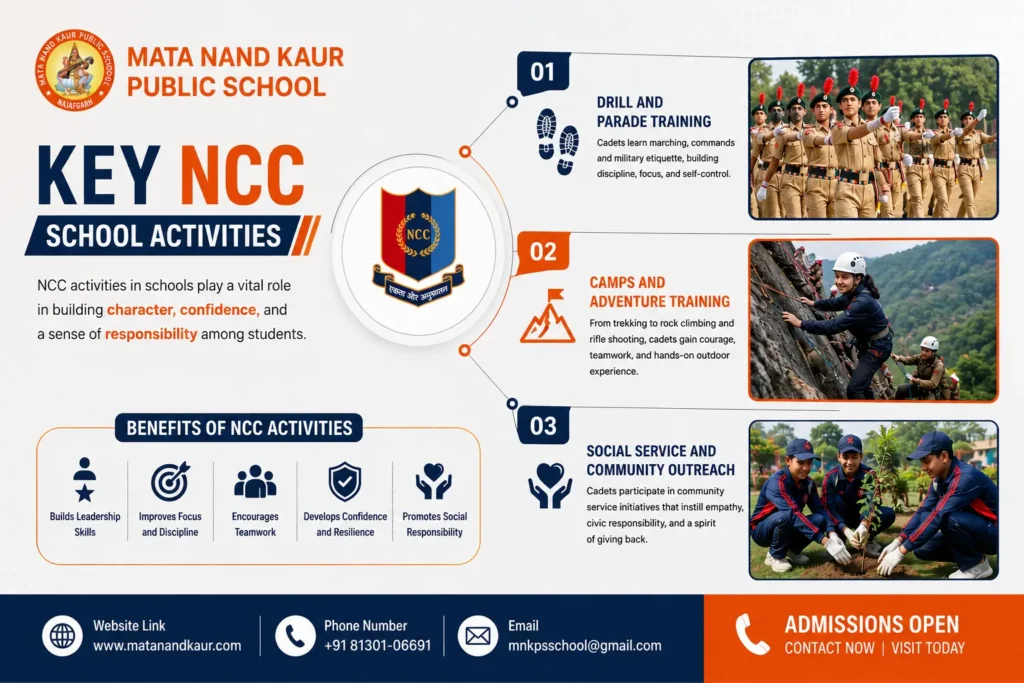
Drill and Parade Training
Drill forms the foundation of NCC training. Cadets learn marching formations, parade commands, and basic military etiquette through regular practice sessions. This builds posture, punctuality, and attention to detail — habits that often carry over into a student’s academic routine and personal discipline at home.
Camps and Adventure Training
Cadets get the opportunity to attend Annual Training Camps, Combined Annual Training Camps (CATC), and selection processes for the Republic Day Camp (RDC) in New Delhi. Many units also organise adventure activities such as trekking, rock climbing, and supervised rifle shooting, giving students hands-on experience well beyond the classroom.
Social Service and Community Outreach
NCC cadets regularly take part in blood donation drives, tree plantation campaigns, cleanliness initiatives, and disaster awareness programmes. This community-facing aspect helps students build empathy, civic responsibility, and a sense of contribution toward society from a young age.
Top Benefits of an NCC Program in Schools
The table below summarises the core advantages an NCC Program in Schools, highlighting the benefits it brings to students and the wider school community.
| Benefit Area | What Students Gain |
| Discipline & Routine | Structured schedule, punctuality, and respect for rules and authority |
| Physical Fitness | Regular drills, endurance training, and overall health improvement |
| Leadership Skills | Command experience, decision-making, and responsibility for a team |
| Confidence & Communication | Public speaking, parade commands, and group coordination |
| Career Readiness | Direct entry advantages for NDA, CDS, and other defence exams |
| Social Awareness | Exposure to community service, camps, and national integration events |
For parents, these outcomes translate into well-rounded development that goes well beyond textbooks, making an active NCC unit a valuable addition to any school’s offerings.
Leadership Development through NCC
One of the most consistent outcomes schools report is the leadership development NCC training provides. Cadets are regularly given roles such as squad commanders, platoon leaders, or camp coordinators, putting them in charge of guiding their peers from an early age. This hands-on responsibility helps students:
- Make quick decisions under pressure during drills and camps
- Take ownership for a team’s performance and discipline
- Communicate instructions clearly in front of groups
- Resolve minor conflicts within a squad or platoon
These are the same skills valued later in higher education, competitive exams, and professional life.
NCC Training in Delhi: What Parents Should Know
Parents researching NCC training Delhi options will find that the NCC functions through regional directorates that coordinate with affiliated schools across the city. In Delhi, NCC units are commonly attached to senior secondary schools, with training conducted on campus by Associate NCC Officers (ANOs) along with visiting instructors from the Army, Navy, or Air Force wings.
Training sessions are usually held once or twice a week, outside core academic hours, so the programme does not interfere with the school timetable. Annual camps take place at designated training grounds, and selected cadets may represent their school at national-level events such as the Republic Day Parade.
Parents enrolling their children should confirm with the school administration whether an NCC unit is active, which wing it belongs to, and the eligibility criteria for students between Class 8 and Class 12.
Career Opportunities After NCC
Completing NCC training, especially up to the ‘B’ or ‘C’ certificate level, opens several doors for students later in their academic and professional journey:
- Defence Services: ‘C’ certificate holders receive direct entry advantages and reserved vacancies during NDA, CDS, and Indian Military Academy selections.
- Paramilitary and Police Forces: Several state police departments and central forces give added weightage to NCC certificate holders.
- Civil Services: The discipline and study habits built through NCC often support better preparation for exams such as UPSC.
- Higher Education Admissions: Many colleges consider NCC certificates as an additional credential under sports or extracurricular quotas.
- Personal Growth: NCC alumni frequently carry forward improved fitness, time management, and leadership habits into professional roles.
Choosing the Right School for NCC: Najafgarh Options
For families in West Delhi searching for schools in najafgarh delhi that combine strong academics with active co-curricular programmes, an NCC Program in Schools is an important factor to consider during the school selection process. When evaluating the best school in najafgarh, parents should ask whether the school has an established NCC unit, qualified ANOs on staff, and a proven track record of cadets participating in camps, parades, selection trials, and other activities associated with a successful NCC Program in Schools.
Among institutions considered for the best school najafgarh, CBSE-affiliated schools generally follow a more standardised co-curricular framework, which often includes NCC, scouting, and structured sports programmes aligned with national guidelines. If you are comparing the best school in najafgarh delhi based on extracurricular strength, it helps to ask how many students are currently enrolled as cadets and which NCC wing the unit is affiliated with.
For parents specifically looking for CBSE schools in najafgarh with an active NCC presence, a campus visit or a direct conversation with the school’s NCC coordinator remains the most reliable way to confirm the quality of the programme before enrolment.
Don’t Miss This Must-Read Blog: – Co-Curricular Activities in Schools: Importance, Types and Impact on Development
Frequently Asked Questions (FAQs)
Students can typically join from Class 8 onward, depending on the school’s affiliation and the eligibility criteria set by the respective NCC directorate.
No, the NCC is voluntary. Students enrol based on interest, and schools with an active unit usually have a limited number of seats each year.
Most schools schedule NCC training once or twice a week, generally outside academic hours, so it does not affect the core curriculum.
The ‘A’ certificate is awarded at the school level, ‘B’ after senior secondary training, and ‘C’ to senior cadets who clear additional exams, with ‘C’ offering the most recognised career benefits.
While NCC is not an academic subject, the discipline and time management it builds often have a positive indirect effect on a student’s overall study routine.
Parents can ask the school administration directly, check the official prospectus, or speak with the Associate NCC Officer (ANO) assigned to the institution.