
June 2026 has been one of the busiest months for CBSE families in recent memory. The Class 10 second board exam results are arriving, the new two-exam system has completed its first full cycle, and Class 11 admissions are opening across Delhi. For parents in Najafgarh, these shifts genuinely change how you should plan the year ahead. Here is a clear, jargon-free guide to the most important CBSE updates 2026 and what each one means for your child.
CBSE Updates 2026: A Snapshot of What Changed This Year
The headline change is structural. CBSE Updates 2026 highlight that CBSE now runs Class 10 board exams twice a year, tests students on understanding rather than memorisation, and gives internal assessment a larger role in the final result. June matters because it is when the first cohort under this reformed system receives its second-attempt scores and begins the move into Class 11, making CBSE Updates 2026 especially important for students, parents, and educators.
Before we look at each update in detail, here is everything at a glance.
| Change | What It Means | Status in June 2026 |
| Two board exams (Class 10) | Phase 1 in Feb–Mar, optional Phase 2 in May | Phase 2 results awaited |
| Best-of-two scoring | Higher of the two attempt scores is counted | Applies to up to 3 subjects |
| Competency-based papers | Around half the paper is MCQ and case-based | In effect |
| Internal assessment | Carries more weight in the final grade | In effect |
| Attendance rule | 75% attendance needed for eligibility | In effect |
| Class 12 exams | Continue as one annual examination | Unchanged |
| Class 11 admissions | Open on the Phase 1 provisional marksheet | Underway |
The Two-Exam System Has Completed Its First Cycle
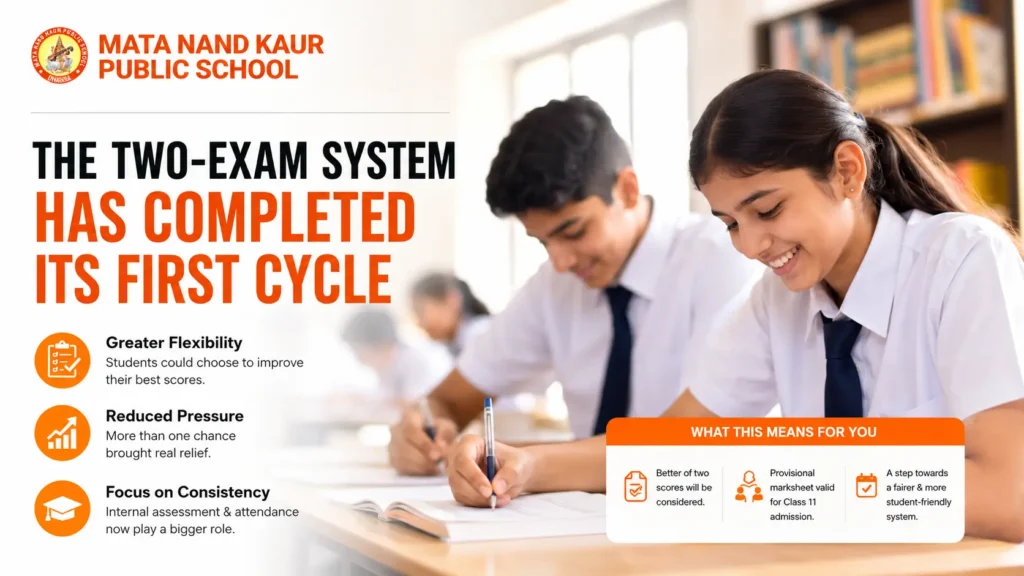
This was the first year that Class 10 students sat board exams in two phases. The first exam ran in February and March, and the optional second exam ran in May. The board considers the higher of the two scores for each subject, so a weaker day in February no longer defines a child’s final result.
The second exam is not compulsory. It is meant for students who want to improve their marks in up to three subjects, or who need to clear a subject. Those who were satisfied with their February performance did not need to reappear at all.
For parents, the practical takeaway is reassurance. A single difficult paper no longer carries the weight it once did, and the pressure of one make-or-break morning has eased considerably. At the same time, the reform asks something in return: because internal assessment and attendance now feed directly into eligibility and final marks, students cannot afford to switch off during the year and rely on a frantic finish. The reward goes to steady, consistent learners.
What the June Result Means for Your Child
If your child sat the second exam, the better of the two scores will appear on the final marksheet. If they skipped it, the first-exam result simply stands. Either way, the provisional marksheet issued earlier is valid for provisional Class 11 admission, so families do not have to wait to begin planning the next step.
CBSE Curriculum Changes Parents Should Understand
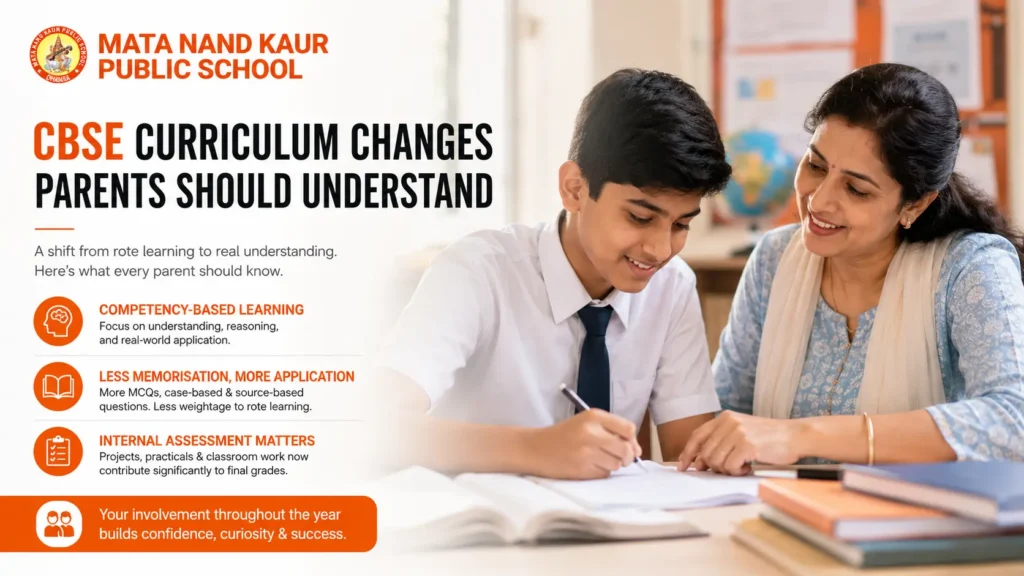
The most important point about the cbse curriculum changes is that the textbook syllabus itself has not been rewritten. What has changed is how students are assessed. Following the National Education Policy 2020, CBSE has moved toward competency-based evaluation, which rewards reasoning and real-world application over rote recall.
Less Memorisation, More Application
Roughly half of each paper now uses multiple-choice, case-based, and source-based questions. Long descriptive answers carry less weight than before. Internal assessment — projects, practicals, and classroom work — now counts for a meaningful share of the grade. In practice, this means steady, year-round effort matters far more than a last-minute cramming push.
This is also why parent involvement looks a little different now. Instead of focusing only on the weeks before exams, the most effective support is helping children stay engaged through the whole session — keeping up with projects, reading beyond the textbook, and building the habit of explaining concepts in their own words. Those are precisely the skills the new question paper is designed to reward.
Class 11 Admissions Are Now Open Across Delhi
June is admission season. With provisional results in hand, schools across the city have started Class 11 enrolment in Science, Commerce, and Arts. Parents should keep both digital and printed copies of the scorecard safe, since it is needed for admission, scholarships, and other formalities. If any detail on the marksheet looks wrong, it should be reported to the school straight away.
How CBSE Schools in Najafgarh Are Adapting
Locally, cbse schools in najafgarh are reworking their academic calendars to fit the two-phase model. That means spreading teaching, revision, and assessment more evenly across the year instead of building everything around a single February exam. Many institutions have added more mock tests, structured internal assessment tracking, and earlier subject counselling so students are not caught off guard by the new paper pattern.
Parents comparing schools in najafgarh delhi should ask how a school is handling these reforms in practice. A well-run CBSE school najafgarh delhi will be transparent about its assessment schedule, its approach to competency-based learning, and how it supports students who choose to reappear in the second exam.
Choosing the Right School in the New CBSE Era
In a system that now rewards consistency, the school you choose matters more than ever. The best school in najafgarh is not simply the one with the highest board scores; it is the one that prepares children for application-based assessment and supports them throughout the year. When shortlisting the best school najafgarh families can trust, look for strong internal assessment systems, regular parent communication, and teachers trained for the updated pattern.
For many parents, the best school in najafgarh delhi is the one that balances academics with skill-building and overall growth — exactly the direction CBSE itself is moving. Take the time to visit, ask questions, and judge each option against how well it fits your child’s needs in this new landscape.
Frequently Asked Questions
The biggest changes are the two-exam system for Class 10, best-of-two scoring, competency-based question papers, and a larger role for internal assessment. Class 12 still has one annual exam.
The second-phase result is expected in the second half of June 2026. Students can check it on the official CBSE result portals, DigiLocker, and the UMANG app once it is released.
No. The first exam is mandatory, but the second is optional. It is meant for students who want to improve their score in up to three subjects, and only the higher score is counted.
The textbook syllabus is largely the same. What changed is the assessment method, which now emphasises competency-based questions and application over memorisation.
Look beyond board results. Choose a school with a clear year-round assessment plan, teachers prepared for the new pattern, and strong support for students who opt for the second exam.
Not in a way that disadvantages students. Provisional marksheets from the first exam are accepted for provisional Class 11 admission, so families can begin the process in June without waiting for the second result. Final passing documents follow once the second-phase result is in.