
There is a moment every parent knows. The bus pulls away from the gate, your child’s face disappears behind the window, and for the next seven hours you simply have to trust someone else.
That trust is the real product a school sells. Everything else, the results, the labs, the annual day photographs, sits on top of it. And yet safety is usually the last thing discussed at an admissions meeting. Parents ask about board results and fee structures. They rarely ask when the last fire drill was held, or who verified the driver’s background. This article makes the case for putting that conversation first, because a child who does not feel safe cannot learn, no matter how good the syllabus is.
Safety Is Not a Facility. It Is the Condition for Everything Else
Think about how learning actually happens. A child has to be willing to raise a hand and be wrong in front of thirty peers. She has to admit she did not understand. He has to try the harder question and risk failing.
None of that happens in a body that is braced for something. A child worried about a bully on the staircase, a teacher who humiliates, or a walk home in the dark is spending energy on vigilance. That energy is not available for algebra.
This is why the most useful definition of school safety is also the broadest. The National Commission for Protection of Child Rights describes school safety as creating a safe environment for children from the moment they leave home to the moment they return, covering protection from abuse, violence, psychosocial difficulties, disasters, fire and transport risks. Emotional safety sits inside that definition deliberately, because distress in children is often invisible to adults until it becomes serious.
A school that understands this builds for it. A school that does not will point at the boundary wall and call the matter settled.
The Five Layers a Secure School Actually Has
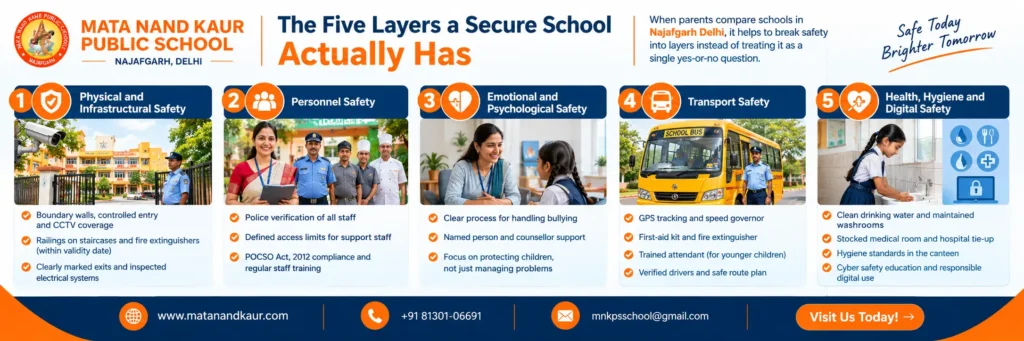
When parents compare schools in Najafgarh Delhi, it helps to break safety into layers instead of treating it as a single yes-or-no question.
1. Physical and Infrastructural Safety
This is the visible layer: boundary walls, controlled entry, CCTV coverage at gates, corridors and stairwells, railings on staircases, fire extinguishers within their validity date, clearly marked exits, and an electrical system that is inspected rather than assumed.
The Central Board of Secondary Education issued Circular No. 01/2022 on student safety, directing affiliated schools to follow the safety frameworks prepared by statutory bodies, including the NCPCR manual and the National Disaster Management Authority’s school safety guidelines. Schools take these seriously or they do not, and the difference shows up in small details: whether the drill register is up to date, whether exits are blocked by stacked furniture.
2. Personnel Safety
Every adult on campus is either a safeguard or a risk. That includes teachers, but also drivers, conductors, housekeeping staff, canteen workers and contractors.
Police verification of all staff is the baseline expectation, along with defined access limits, so that support staff are not moving unsupervised through areas where children are alone. India’s legal framework here is firm. The Protection of Children from Sexual Offences (POCSO) Act, 2012 sets out clear obligations and penalties, and every school is expected to have staff trained in what the law requires of them.
3. Emotional and Psychological Safety
This layer is the hardest to inspect and the easiest to fake, which is exactly why it deserves attention.
Ask how bullying is handled. Not whether it happens, because it happens everywhere, but what the process is when it does. Is there a named person a child can go to? Is there a counsellor? Does the school treat a bullied child as a problem to be managed or a person to be protected?
Bullying erodes self-esteem and leaves children in a state of daily stress about their own wellbeing. The academic cost follows quietly, months later, in falling marks that everyone misreads as laziness.
Read Also: Follow These 7 Safety Rules at School for Child’s Protection
4. Transport Safety
For families travelling in from Dhansa, Jharoda Kalan, Chhawla, Kair and the stretches towards Dwarka, the bus is a part of the school day that parents never see.
A properly run school transport operation has GPS tracking, a speed governor, a first-aid kit, a valid fire extinguisher, a trained attendant on routes with younger children, verified drivers, and a route plan that does not keep a six-year-old on the road for ninety minutes each way.
Read Also: A Parent’s Guide to School Bus Routes and Safety in Najafgarh & Dwarka
5. Health, Hygiene and Digital Safety
Clean drinking water, maintained washrooms, a stocked medical room, a tie-up with a nearby hospital for emergencies, and hygiene standards in the canteen all belong here.
So does the newest layer: digital safety. Children now use school devices, submit work online and carry phones home. Schools that teach cyber safety explicitly, rather than banning devices and hoping for the best, are preparing children for the world they will actually live in.
Walk the campus, meet our staff, and ask the questions that matter most to you.
What a Safe Environment Does to a Child Over Ten Years
Safety pays out slowly, which is why it is undervalued at admission time. Here is what it compounds into.
- Attendance holds: A child who feels comfortable does not invent stomach aches on Monday morning. Attendance is the single most boring predictor of academic outcome, and it is largely an emotional variable.
- Participation grows: Children in secure classrooms volunteer answers, join debates, try out for teams. Each of those moments is a small deposit into confidence, and confidence is what shows up in a Class 12 interview a decade later.
- Risk-taking becomes healthy: The child who is allowed to be wrong safely becomes the adult who is willing to try. That single trait separates people who grow in their careers from people who stall.
- Relationships with adults stay open: Children in schools with clear reporting channels learn that telling an adult produces help rather than trouble. This habit protects them long after they leave the school gate.
- Academic performance follows: Not because safety teaches mathematics, but because it removes the thing that was blocking mathematics.
Read Also: Why Is Choosing Schools in Najafgarh More Than Just Academics?
Nine Questions to Ask Before You Sign the Admission Form
Take these to your next school visit. Ask them plainly. How a school answers tells you as much as the answer itself.
- Is police verification completed for every staff member, including drivers, helpers and contract workers?
- Where exactly is CCTV installed, and who reviews the footage?
- When was the last fire and evacuation drill, and may I see the register?
- Who is the designated person a child can approach with a complaint?
- Is there a trained counsellor on campus, and how often is she available?
- What is your written procedure when a bullying incident is reported?
- What is your dispersal protocol if an unfamiliar adult arrives to collect a child?
- Is there a functioning medical room, and which hospital do you contact in an emergency?
- Are buses fitted with GPS and speed governors, and do younger routes carry a female attendant?
A school that welcomes these questions is a school that has already thought about them.
We will answer every one of them, on record, before you decide anything.
How Mata Nand Kaur Public School Approaches Safety
At our campus in Dhansa, Najafgarh, safety is treated as everyday practice rather than an annual compliance exercise. Supervised movement between classes, controlled entry and dispersal, maintained facilities, and staff who know children by name form the ordinary texture of the school day.
That thinking extends into the learning spaces themselves. Practical work in the Chemistry, Physics and Biology laboratories is conducted under supervision with defined protocols, the playground is divided into age-appropriate zones, and the multipurpose hall allows large gatherings to be held indoors without crowding.
Emotional safety is supported through the house system, which gives every child a smaller group to belong to within a large school, and through counselling support for students who need guidance. You can read more about our approach and values on the About Us page.
As one of the established CBSE schools in Najafgarh, we would rather have parents ask us difficult questions before admission than discover gaps afterwards. If you are searching for the best school in Najafgarh Delhi, we would suggest making safety the first filter you apply, whichever campus you eventually choose.
Read Also: Importance of Self Defence Education for Girls in Delhi Schools
Frequently Asked Questions
It covers far more than physical security. Official guidance treats it as protection from abuse, violence, psychosocial harm, natural and man-made disasters, fire and transport risk, extending from the child’s home to the school and back.
No. CCTV records events after they occur. Real safety comes from verified staff, trained teachers, clear reporting channels, supervision during transitions, and a culture where children believe they will be heard.
Ask for the written anti-bullying procedure and the name of the person responsible for it. Schools that have genuinely thought about this answer immediately. Schools that have not will speak in generalities.
Take it seriously, write down what your child tells you, and raise it with the class teacher and the principal in writing. Keep a record of the school’s response. Most issues resolve quickly once they are documented.
Not necessarily. Many safety practices are matters of process and discipline rather than expenditure. Supervision during dispersal, updated drill registers and verified staff records cost attention, not money.