
Ask any Class 10 or Class 12 student where their internal assessment marks quietly slip away, and the answer is rarely the theory paper. It’s the practical file that’s missing a diagram, the viva answer that gets fumbled under pressure, or an experiment that technically “worked” but wasn’t recorded the way an examiner wants to see it. Practical marks look easy on paper—attend the lab, do the experiment, write it up—but the students who consistently score full or near-full marks are doing something slightly different from everyone else in the room. MNKPS Laboratories for Perfect Practical Marks provide the right environment, hands-on guidance, and structured practice to help students perform experiments accurately, strengthen their practical understanding, and maximize their internal assessment scores.
This guide walks through exactly how to make the most of MNKPS’s Physics, Chemistry, Biology, and Computer Science labs across Classes 9 to 12 — not generic lab-safety advice, but the specific habits, manual formats, and viva preparation that actually move the needle on a final practical score.
Why Lab Performance Carries So Much Weight in Internal Assessment
Under CBSE’s evaluation structure, practical and internal assessment marks aren’t a minor add-on — they can make up anywhere from 20 to 30 marks of a subject’s total score in the senior years, and the weight only increases for science subjects at the Class 11 and 12 level. Unlike a board theory paper, where one weak question can be offset by strong answers elsewhere, practical assessment is evaluated across several smaller components — the experiment itself, the lab record, and the viva — which means small, consistent gaps across all three tend to add up quickly.
How Practical Marks Are Typically Broken Down
Most CBSE science practicals split marks across three areas: the actual conduct of the experiment (accuracy, technique, and observation), the lab record or manual (how clearly and correctly the work is documented), and the viva voce (how well a student can explain what they did and why). A student can perform an experiment flawlessly and still lose marks if the manual is disorganised or the viva answers reveal they didn’t fully understand the underlying concept. Treating all three as equally important, rather than focusing only on “getting the experiment right,” is where most of the score difference actually comes from. MNKPS Laboratories for Perfect Practical Marks help students strengthen each of these areas through hands-on practice, proper experiment documentation, and regular viva preparation, improving their chances of securing top practical scores.
Getting the Most Out of the Physics Lab
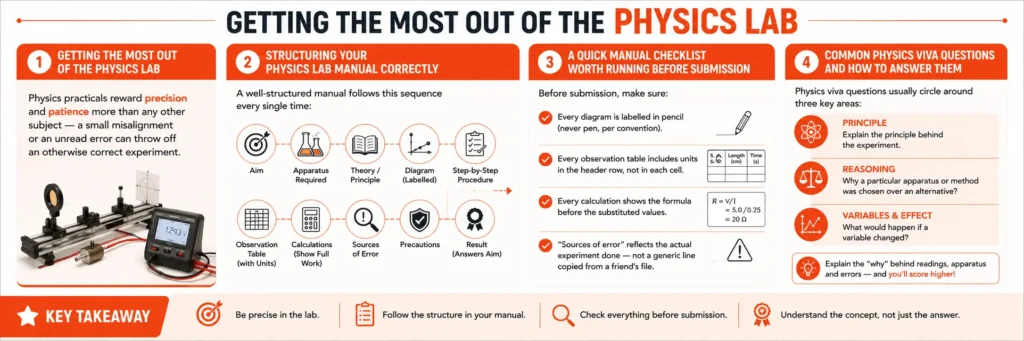
Physics practicals in the Physics Lab tend to reward precision and patience more than any other subject—a slightly misaligned optical bench or an unread error margin can throw off an otherwise correct experiment.
Structuring Your Physics Lab Manual Correctly
A well-structured Physics manual follows a consistent sequence every single time: aim, apparatus required, theory or underlying principle, a clean and labelled diagram, a step-by-step procedure, an observation table with proper units, calculations shown in full (not just the final answer), sources of error, precautions, and a final result statement that directly answers the aim. Examiners notice when this structure is followed consistently across every experiment in the file because it signals genuine understanding rather than copied entries. MNKPS Laboratories for Perfect Practical Marks guide students to maintain this structured approach in every practical record, helping them present accurate, organized, and examiner-friendly lab manuals that earn higher internal assessment marks.
A Quick Manual Checklist Worth Running Before Submission
Before handing in a Physics file, it’s worth checking that every diagram is labelled in pencil (never pen, per convention), every observation table includes units in the header row rather than repeated in each cell, every calculation shows the formula before the substituted values, and the “sources of error” section reflects the actual experiment done — not a generic line copied from a friend’s file.
Common Physics Viva Questions and How to Answer Them
Physics viva questions usually circle around three things: the principle behind the experiment, why a particular apparatus or method was chosen over an alternative, and what would happen if a variable changed. A student who can explain why a screw gauge is more precise than a ruler for a given measurement, or why a particular error margin exists in a reading, tends to do far better than one who has only memorised the final numerical result.
Getting the Most Out of the Chemistry Lab
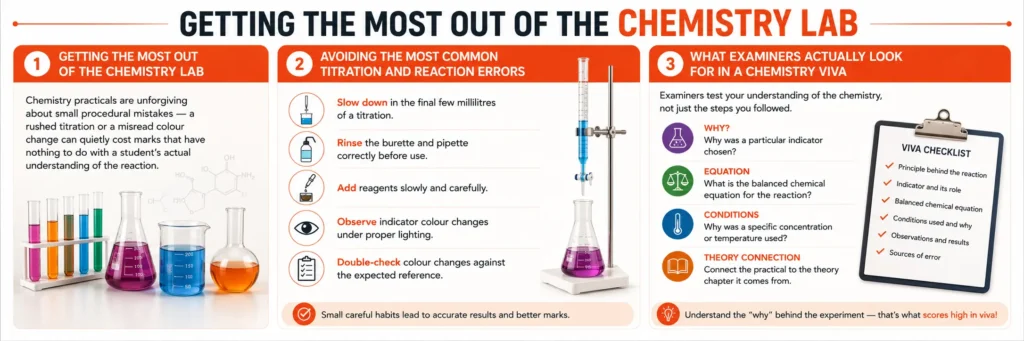
Chemistry practicals in the Chemistry Lab are unforgiving about small procedural mistakes—a rushed titration or a misread colour change can quietly cost marks that have nothing to do with a student’s actual understanding of the reaction.
Avoiding the Most Common Titration and Reaction Errors
The most frequent point loss in Chemistry practicals comes from rushing the endpoint in a titration, adding a reagent too quickly, or misjudging a colour change under classroom lighting. Slowing down in the final few millilitres of a titration, rinsing the burette and pipette correctly before use, and double-checking indicator colour changes against the expected reference rather than assuming a change has occurred are small habits that consistently protect accuracy.
What Examiners Actually Look for in a Chemistry Viva
Chemistry viva questions typically test whether a student understands the chemistry behind a reaction, not just the mechanical steps. Expect questions on why a particular indicator was chosen, what the balanced chemical equation for the reaction is, and why a specific concentration or temperature was used. Students who can connect the practical back to the theory chapter it’s drawn from — rather than treating the lab session as a separate, disconnected activity — handle these questions with far more confidence.
Getting the Most Out of the Biology Lab
Biology practicals in the Biology Lab are often underestimated because they can feel more observational than technical, but examiners are just as strict about accuracy, presentation, and attention to detail.

Presenting Specimens, Slides, and Diagrams the Right Way
Biology diagrams are graded on both accuracy and labelling convention — labels should be written in pencil with straight, ruler-drawn lines, never overlapping, and positioned so the diagram remains the clear focal point of the page. When working with slides or specimens, noting magnification, staining technique used, and key identifying features in the observation section (rather than just naming the specimen) demonstrates a level of understanding that a bare label doesn’t.
Biology Viva: Questions That Trip Up Even Well-Prepared Students
The most common stumbling block in a Biology viva isn’t identifying a specimen — it’s explaining its classification, function, or significance in the broader chapter it belongs to. A student should be ready to explain not just “what is this” but “why does this structure look the way it does” or “how does this relate to the process we studied in class.” That connective explanation is usually what separates a good viva from an excellent one.
Getting the Most Out of the Computer Lab
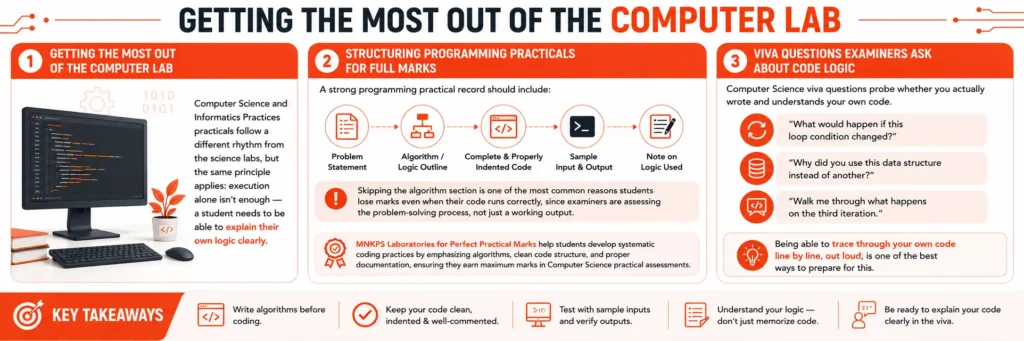
Computer Science and Informatics Practices practicals in the Computer Lab follow a different rhythm from the science labs, but the same principle applies: execution alone isn’t enough—a student needs to be able to explain their own logic clearly.
Structuring Programming Practicals for Full Marks
A strong programming practical record includes the problem statement, the algorithm or logic outline before the code itself, the complete and properly indented code, sample input and output, and a brief note on the logic used. Skipping the algorithm section is one of the most common reasons students lose marks even when their code runs correctly, since examiners are assessing the problem-solving process, not just a working output. MNKPS Laboratories for Perfect Practical Marks help students develop systematic coding practices by emphasizing algorithms, clean code structure, and proper documentation, ensuring they earn maximum marks in Computer Science practical assessments.
Viva Questions Examiners Ask About Code Logic
Computer Science viva questions tend to probe whether a student actually wrote and understands their own code — expect questions like “what would happen if this loop condition changed,” “why did you use this data structure instead of another,” or “walk me through what happens on the third iteration.” Being able to trace through your own code line by line, out loud, is one of the best ways to prepare for this.
Five Habits That Separate Average Practical Scores from Perfect Ones
Across all four labs, a few habits show up again and again in students who consistently score at the top end: they complete their manual entry on the same day as the experiment rather than days later from memory; they read the theory chapter connected to each experiment before the lab session, not after; they practise explaining their experiment out loud to a classmate or parent, not just silently reviewing notes; they ask their lab teacher “why” questions during the session rather than saving every doubt for revision week; and they treat error and precaution sections as genuine analysis rather than boilerplate lines copied from a previous batch’s file.
How MNKPS Labs Are Built to Support This
At Mata Nand Kaur Public School, the Physics, Chemistry, Biology, and Computer Science labs are equipped and staffed specifically to make these habits easy to build rather than something students have to figure out alone. Lab teachers walk students through manual formatting from the very first practical of the year, use viva-style questioning during regular sessions rather than only before exams, and keep equipment calibrated and well-maintained so that experimental error stays genuinely instructive rather than a source of confusion. For families comparing options among CBSE schools in Najafgarh Delhi, this kind of consistent, hands-on lab culture is often the difference between a student who merely completes their practicals and one who is genuinely confident walking into a viva.
Want to see our Physics, Chemistry, Biology, and Computer labs in action?
Frequently Asked Questions
For science subjects at the senior secondary level, practical and internal assessment marks typically make up 20 to 30 marks of the total, which is significant enough that consistent small losses across experiments can meaningfully affect the final grade.
Practical evaluation covers the experiment, the lab manual, and the viva as separate components — a correct result doesn’t compensate for a disorganised manual or weak viva answers, so all three need equal attention.
Copying entries or explanations from a classmate’s file, especially in the “sources of error” or “precautions” sections, is one of the easiest mistakes for an examiner to spot and one of the most avoidable.
Explaining the experiment out loud — the principle, the procedure, and what would happen if a variable changed — is far more effective preparation than silently re-reading notes, since viva questions test the ability to articulate understanding, not just recall it.
It matters more than students often realise — well-maintained, properly calibrated equipment means experimental results are genuinely instructive, and error margins reflect real technique rather than equipment inconsistency, which makes both the experiment and the viva easier to handle confidently.